PCR Percentage Guide

How Much PCR Content Is Realistic for Your Packaging?

You've committed to recycled content — now you need a number you can actually hit. Here's what 20%, 50%, and 100% PCR each demand from your supply chain, your budget, and your customers' eyes.

View PCR Products
Realistic Targets
Retailer Ready
PCR Expert Guide
Realistic PCR Content Levels for Packaging | Achieve Pack
Click to enlarge

Key Takeaways

Share:
  • Start at 20-30%: Easiest to source, lower quality risk, meets most retailer expectations
  • 50%+ for hero products: Stronger signal, requires more tolerance for aesthetic variation
  • 100% is challenging: Best suited for rigid/opaque formats, not recommended as SME starting point
  • Document properly: Specify which components contain PCR and provide certifications

"What Percentage Should We Aim For?"

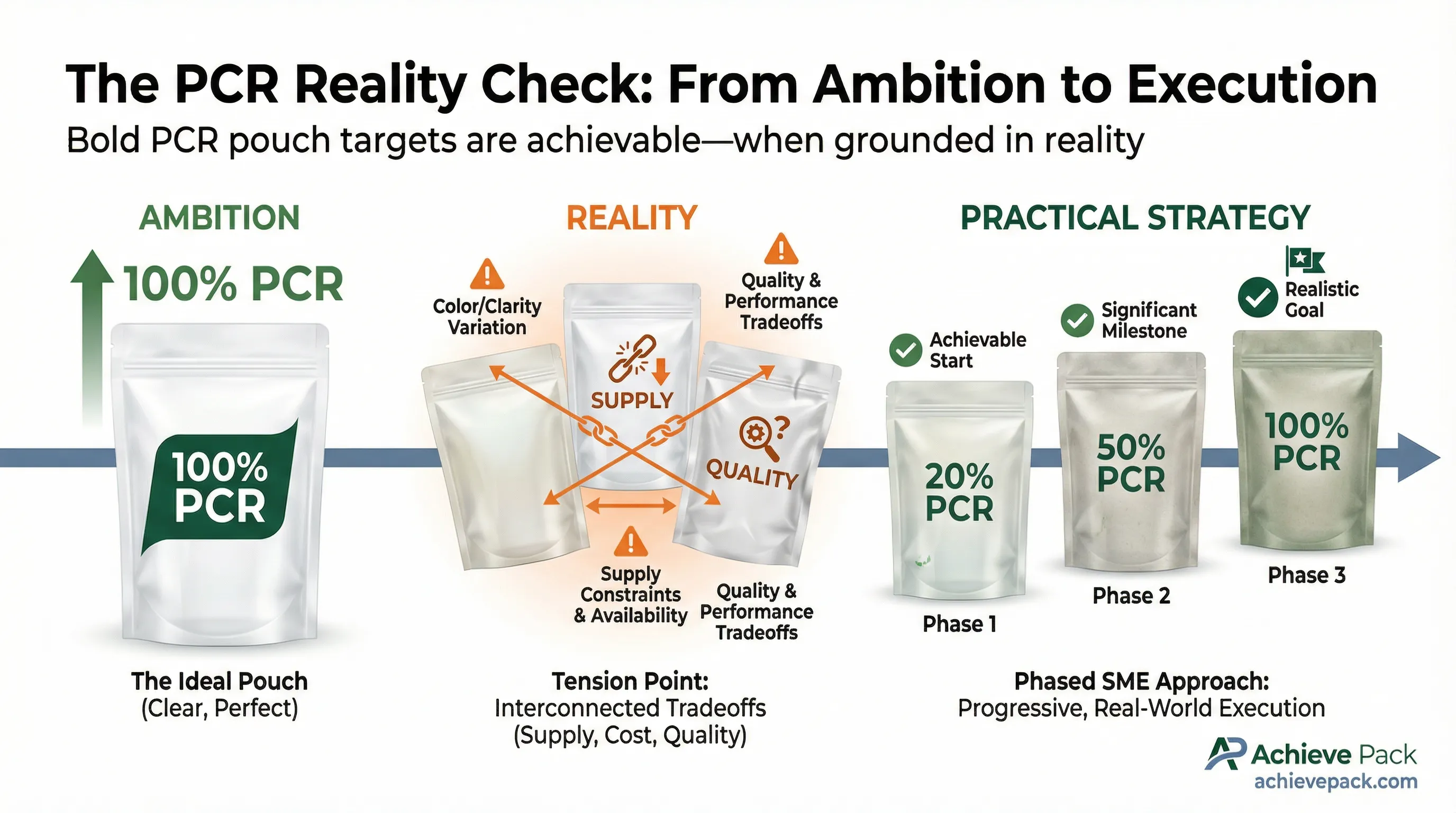
Once you decide to use PCR, the practical question is "how much?" A 100% PCR claim sounds strong, but supply, quality, and cost realities mean it's rarely the right first move — especially if you're an SME brand ordering flexible packaging at modest volumes.

This guide walks you through what each PCR level actually requires, what retailers expect to see, and how to pick a starting percentage you can defend — and sustain — order after order.

What Does "X% PCR Content" Actually Mean?
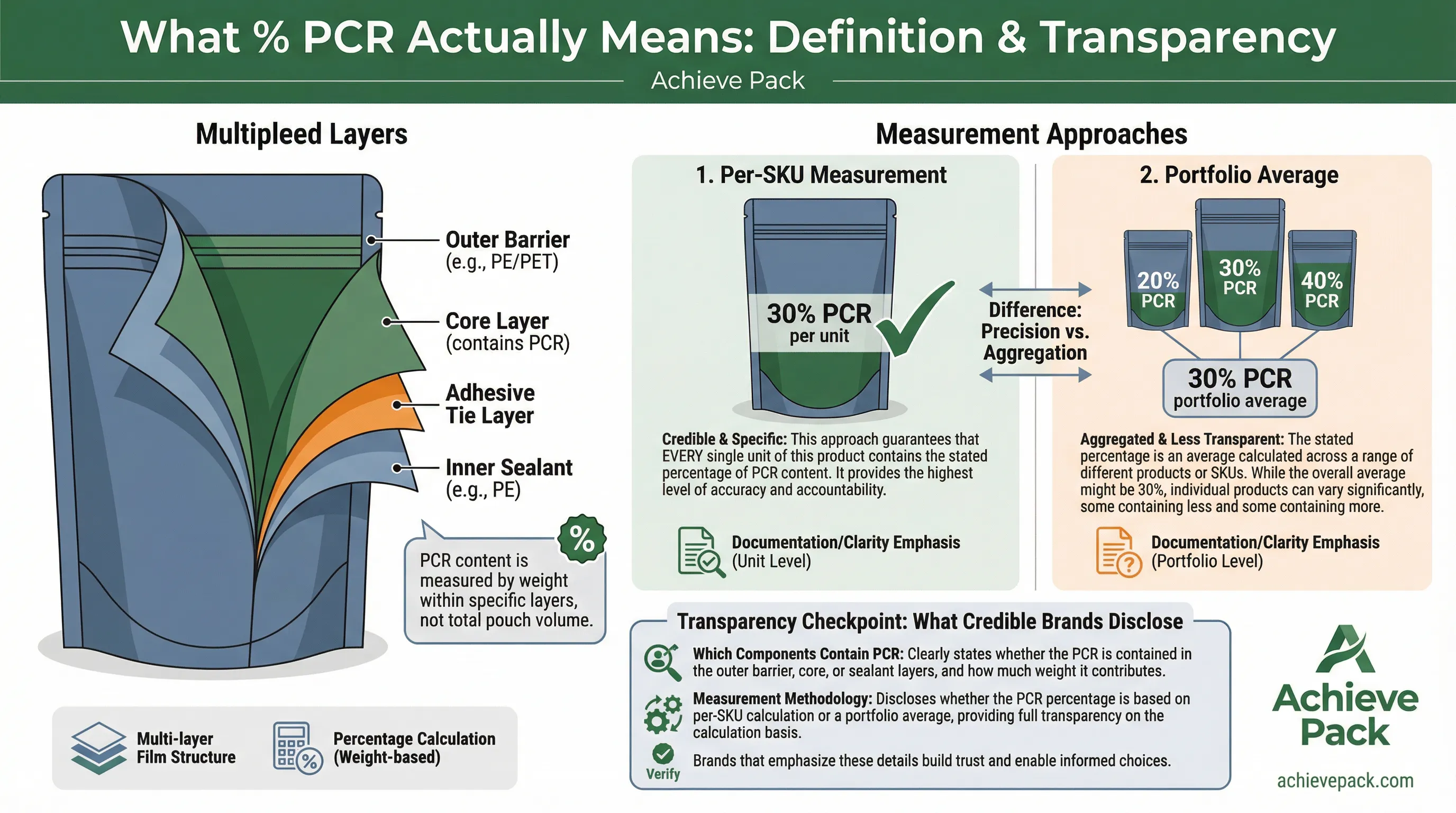
PCR percentage refers to the share of recycled plastic by mass
Click to enlarge

What Does "X% PCR Content" Actually Mean?

"30% PCR content" typically refers to the share of plastic in a packaging component that comes from post-consumer recycled sources by mass.

In multi-layer films, that percentage might apply only to a specific layer or the whole structure, depending on design and disclosure.

For clarity and credibility, specify:

  • • Which components contain PCR (e.g., "film" vs "closure")
  • • Whether percentage is averaged across portfolio or guaranteed per SKU

Industry Context: Where Targets Are Heading

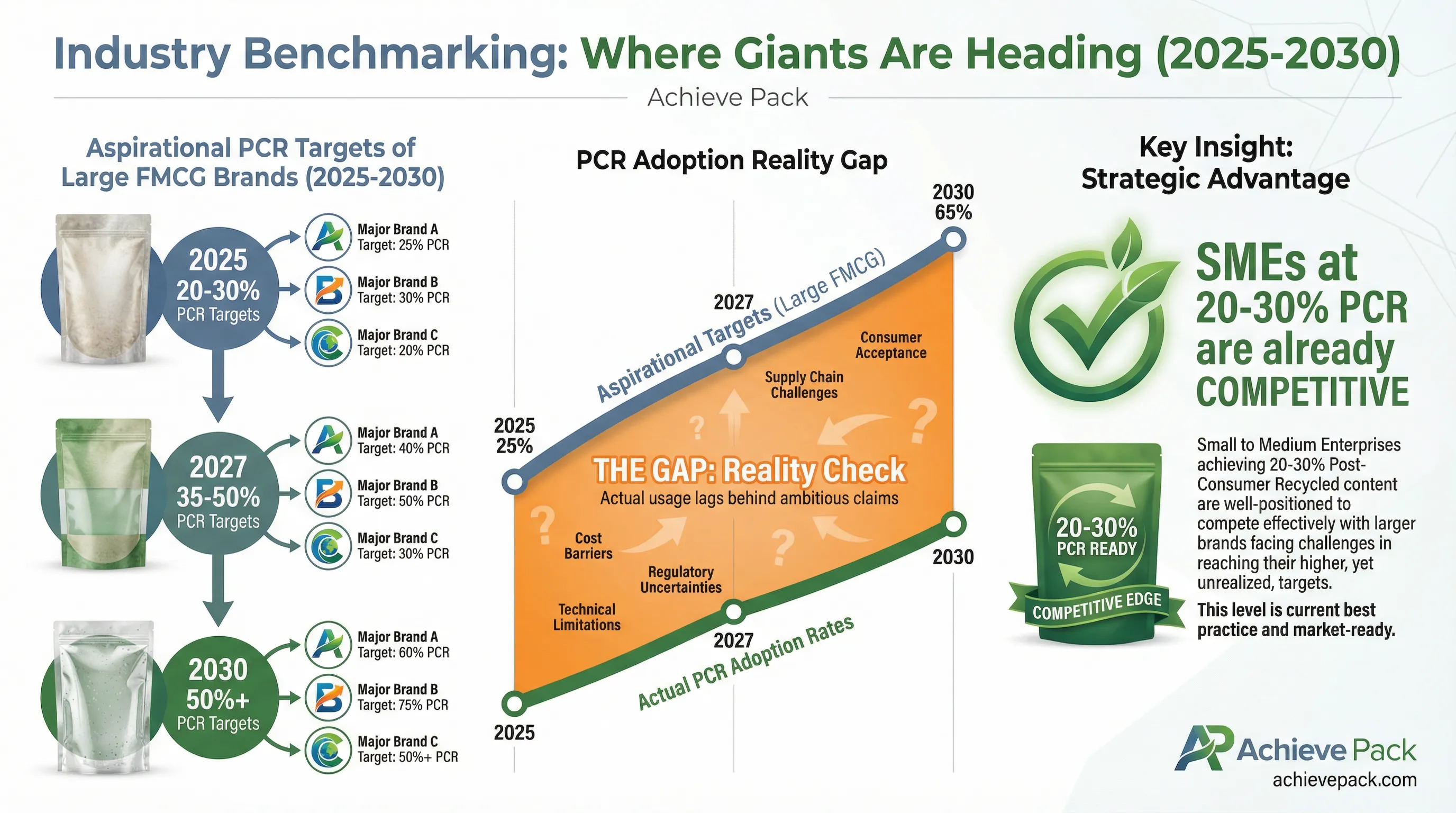
Many large FMCG and retail brands have publicly committed to 20-30% average PCR content in plastic packaging by 2025-2030. Yet actual PCR usage is still much lower in many segments.

For SMEs, this means:

  • • Setting 20-30% target on selected SKUs already aligns with bigger players
  • • Higher targets (50-100%) can be powerful on hero products but aren't always practical portfolio-wide
Industry Context: Where Targets Are Heading
Many large brands target 20-30% average PCR by 2025-2030
Click to enlarge
The Practical Starting Point
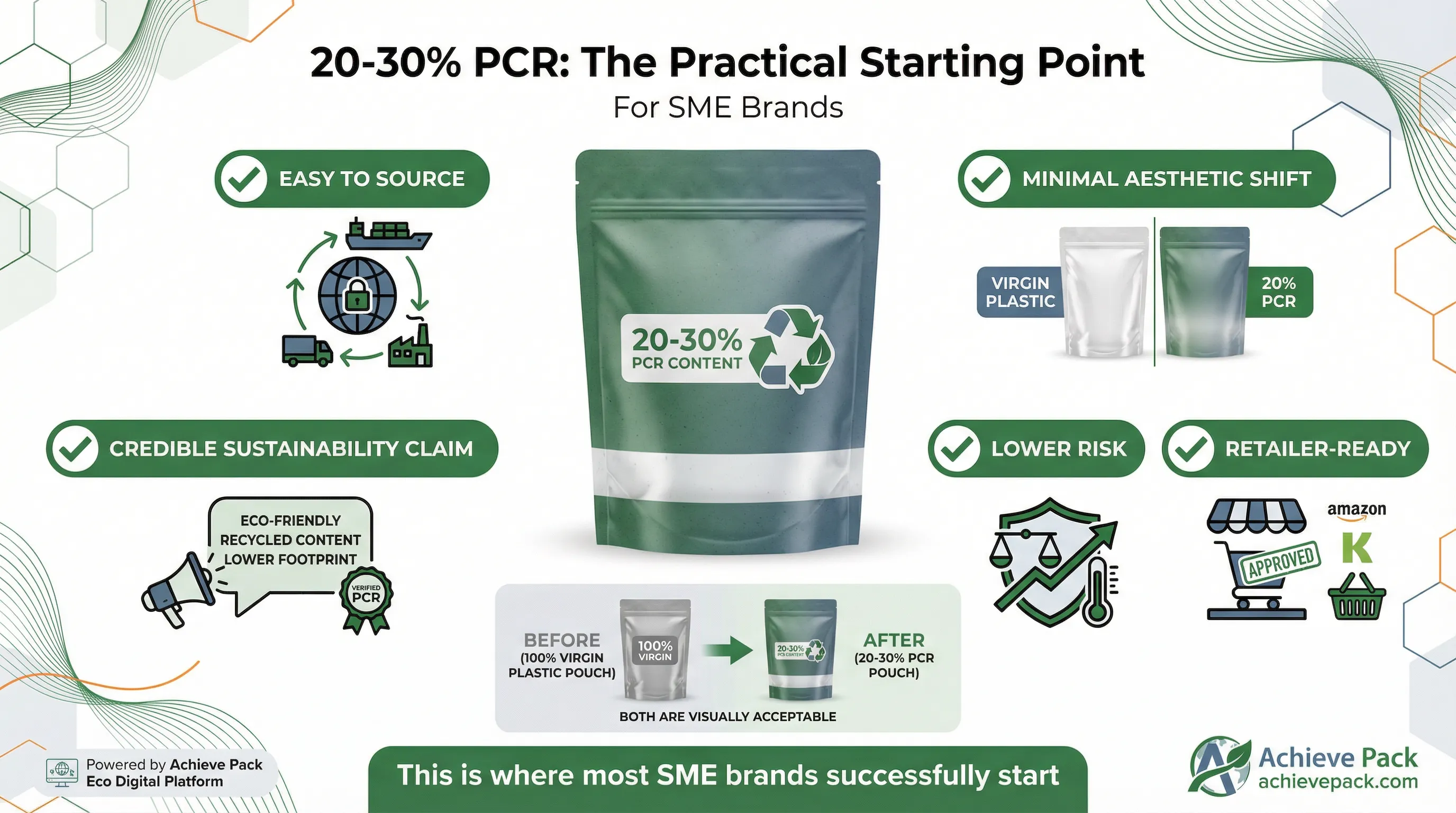
20-30% PCR is the practical starting point for most SME brands
Click to enlarge
20-30%

The Practical Starting Point

  • Easiest to source and qualify
  • Lower risk of noticeable color or clarity shifts, especially in printed films
  • Significant enough to make credible "reduced virgin plastic" claims
  • Satisfies early retailer expectations

This is where most SME brands start, and where Achieve Pack often positions initial Eco Digital PCR structures.

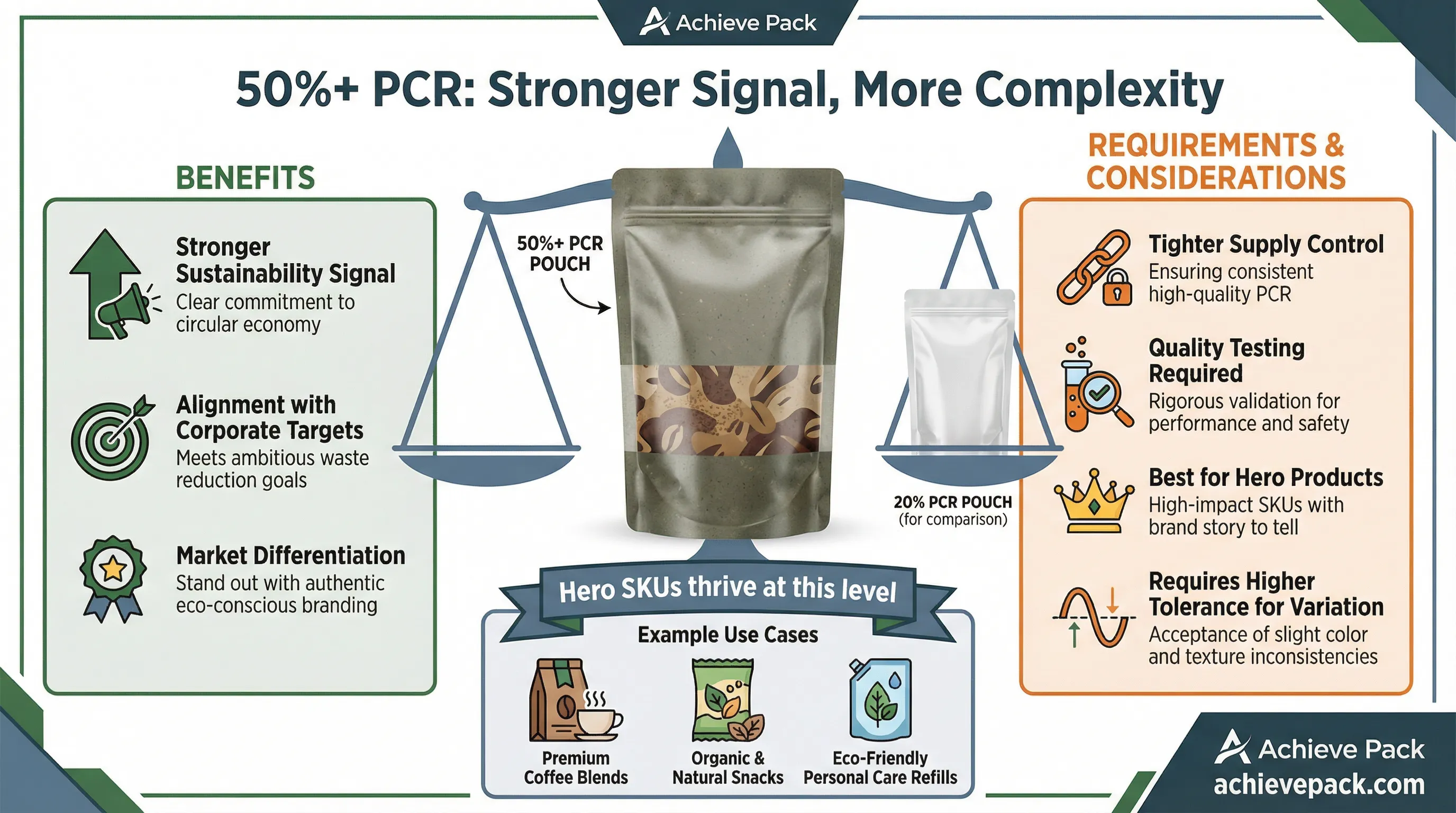
50%+

Stronger Signal, More Complexity

  • Sends a clear sustainability signal to markets and stakeholders
  • Requires tighter control of supply and quality
  • More thorough testing needed

Best suited for hero SKUs and categories where slight aesthetic variation is acceptable. Eco Digital PCR pouches at this level work well for brands comfortable embracing a more "recycled" look and story.

Stronger Signal, More Complexity
50%+ PCR sends a clear sustainability signal
Click to enlarge
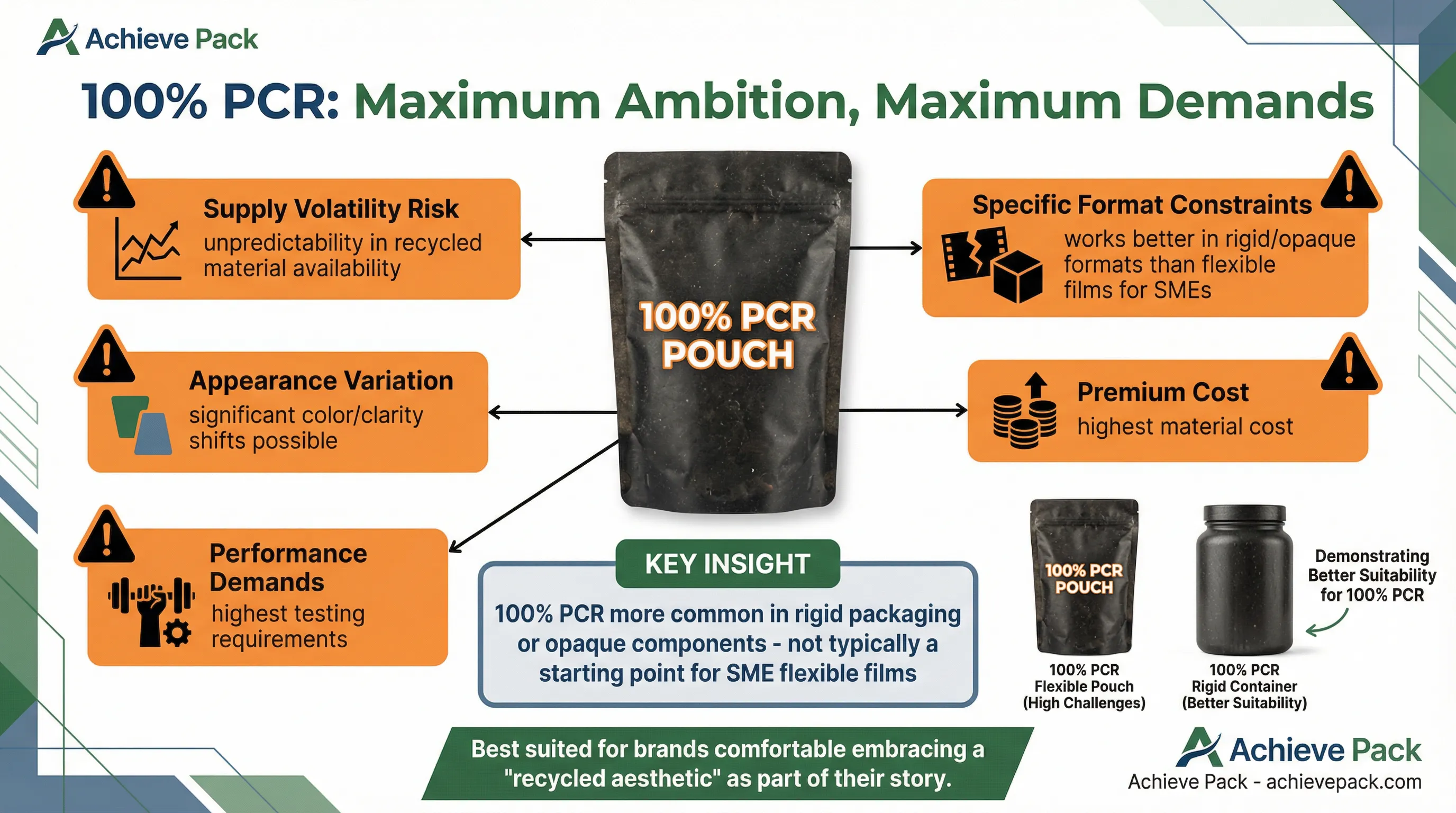
Maximum Recycled Content, Maximum Demands
100% PCR demands highest tolerance for variation
Click to enlarge
100%

Maximum Recycled Content, Maximum Demands

  • Provides a compelling headline and aligns with aggressive targets
  • Demands highest tolerance for appearance variation
  • Potential supply volatility

Not recommended as a starting point for most SMEs, especially where brand visuals rely on high clarity. In practice, 100% PCR is more often used in rigid formats or opaque components than in flexible films.

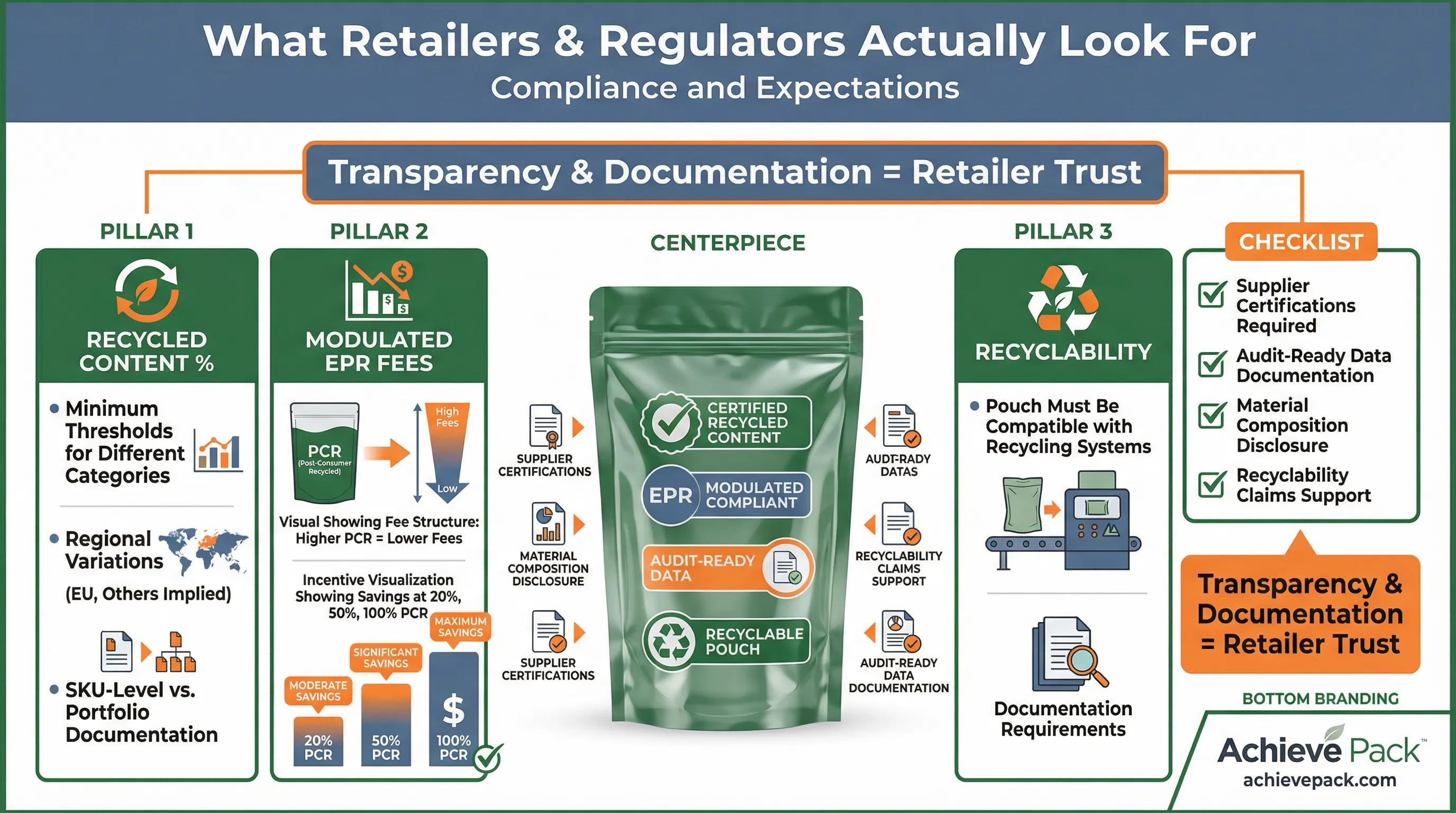
What Retailers and Regulators Actually Look For

Retailers and regulators are moving toward a mix of:

  • Minimum recycled content thresholds in certain categories or markets
  • Modulated EPR fees that reward higher recycled content and recyclability

SME brands can stay ahead by:

  • • Understanding national/regional targets for recycled content
  • • Aligning at least a subset of SKUs with those thresholds
  • • Documenting PCR content with supplier certifications
What Retailers and Regulators Actually Look For
Retailers are moving toward minimum recycled content thresholds
Click to enlarge
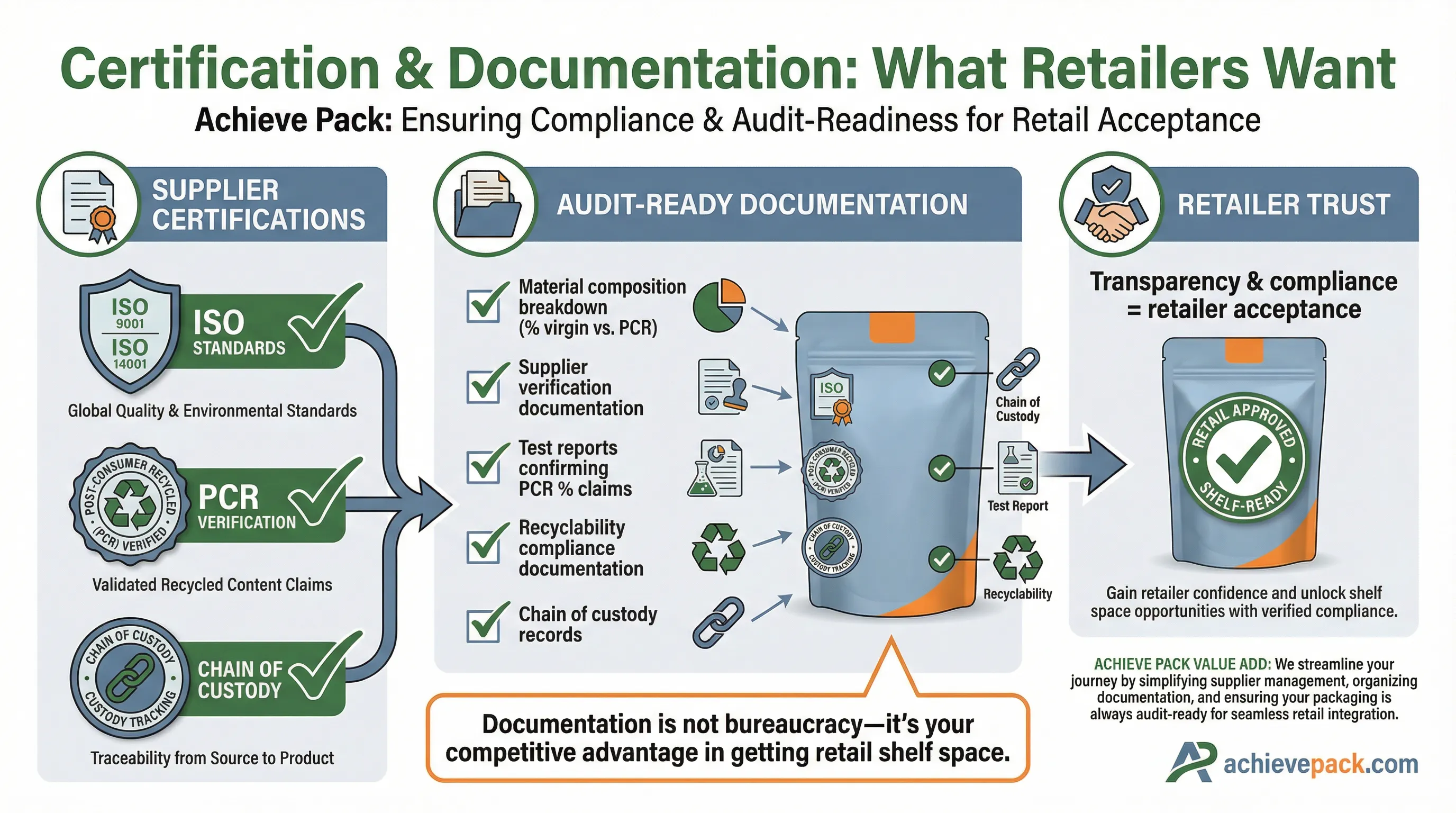
Documenting Your PCR Content
Proper documentation is essential for credible PCR claims
Click to enlarge

Documenting Your PCR Content

Credible PCR claims require proper documentation:

GRS Certification

Global Recycled Standard provides third-party verification

Chain of Custody

Traceability from recycled feedstock to finished product

Audit-Ready Data

PCR percentage, source, and compliance documentation

How Achieve Pack Helps You Choose

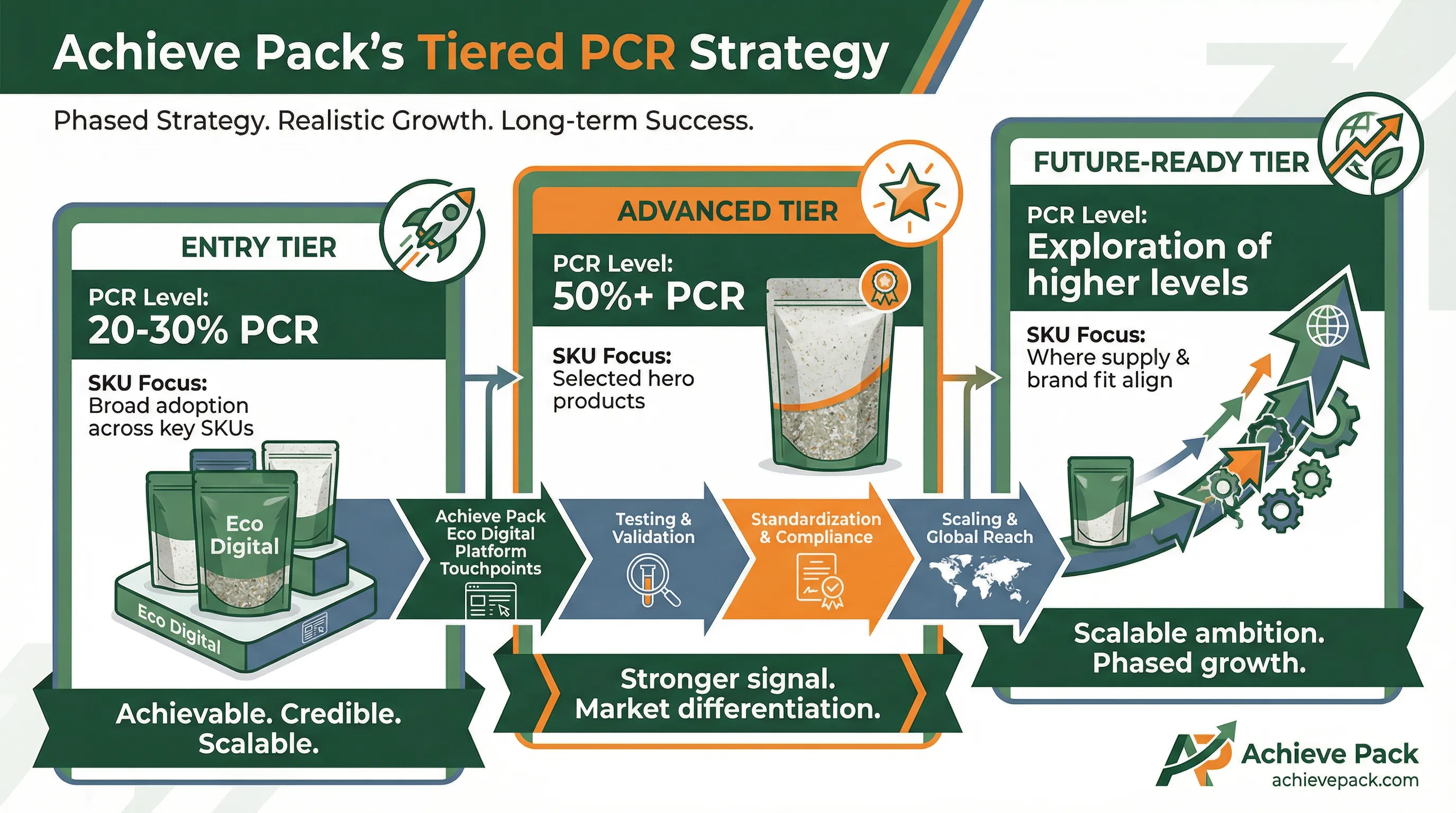
Achieve Pack works with SME brands to define tiered PCR strategies rather than one-size-fits-all targets:

Entry Tier

Eco Digital structures with 20-30% PCR for broad adoption across key SKUs

Advanced Tier

50%+ PCR on selected hero products, embracing the recycled aesthetic

Future-Ready Tier

Exploration of higher PCR levels where supply, performance and brand fit align

Our Eco Digital platform allows you to test different PCR levels with minimal upfront cost, then standardize around what works best.

How Achieve Pack Helps You Choose
Tiered PCR strategies for different needs
Click to enlarge

5 Common PCR Problems (And Solutions)

Contamination & Impurities

Recycled plastics often contain impurities, leading to black specks or discoloration.

Solution: Multi-stage filtration and sorting technology ensures high purity.

Structural Weakness

High PCR content can compromise tensile strength, making packaging brittle.

Solution: Co-extrusion with virgin resin layers provides robust structural support.

Unpleasant Odors

Residual smells from previous contents can remain in recycled plastic.

Solution: Advanced deodorization and outgassing during the pelletizing process.

Inconsistent Coloring

PCR batches vary in base color, making precise brand color matching difficult.

Solution: High-opacity masterbatches or strategic dark-colored packaging designs.

Processing Instability

PCR melts at different temperatures, causing uneven thickness.

Solution: Specialized extrusion screws and real-time thickness monitoring.

5 Common PCR Problems (And Solutions)
Click to enlarge

What PCR Content Will NOT Do

  • • NOT a recyclability claim. A GRS certificate verifies recycled content. Whether your pouch can be recycled after use depends on its structure — a multi-material PCR laminate is still hard to recycle.
  • • NOT compostable or biodegradable. PCR is conventional plastic with recycled feedstock. It belongs in the recycling stream; never pair it with compostable messaging.
  • • NOT the same number at every supplier. Some quote PCR per SKU, others as a portfolio average across components. Ask which components carry PCR and get it in writing before you print a percentage.
  • • NOT always available at 100% for flexible films. High-content PCR film has visible variation and supply can be volatile. If a supplier promises 100% PCR film with virgin-like clarity at any volume, ask for batch samples first.

Want to compare 30%, 50%, and 100% side by side? Order the $40+ sample kit (credited toward your first order) or talk to our team.

Pick a PCR Level You Can Sustain

The right percentage is the one you can source, document, and reorder consistently — not the biggest number on the shelf. Start with a 500 pc digitally printed run, test it with your retailers, then scale with gravure at roughly 45% lower unit cost.

Get PCR Samples

Frequently Asked Questions

What PCR percentage should I start with?
We recommend starting with 20-30% PCR content. This range is typically the easiest to source and qualify, with lower risk of noticeable color or clarity shifts. It's significant enough to make credible sustainability claims while being practical for most SME brands.
Will retailers accept 20% PCR content?
Yes, many large FMCG and retail brands have publicly committed to 20-30% average PCR content by 2025-2030. Starting at 20% already aligns with what many bigger players are aiming for overall, making it acceptable to most retailers.
Is 100% PCR realistic for flexible packaging?
100% PCR is more challenging for flexible films due to appearance variation and supply volatility. It's more commonly achieved in rigid formats or opaque components. For most SME brands using flexible packaging, 100% PCR is not recommended as a starting point.
How do I document PCR content for retailers?
Document your PCR content with supplier certifications (like GRS - Global Recycled Standard), chain of custody documentation, and audit-ready data. Specify which components contain PCR and whether percentages are per SKU or portfolio average.
What's the difference between 30% and 50% PCR?
30% PCR is easier to source with minimal visual impact, good for broad adoption. 50%+ PCR sends a stronger sustainability signal but requires tighter supply control and more tolerance for aesthetic variation. Best suited for hero products.
Still reading the footer? You must be serious.
$40+ sample kit — credited to your first order. Or book 15 minutes with a human.
Get the Sample KitBook a Call
WhatsApp (Real Person)LIVE
Book Meeting (Real Person)1:1
AI Packaging Assistant

We use cookies to improve your experience. View our Cookie Policy.