Prioritisation Guide

100% Recyclable Packaging vs PCR vs Bio‑Based: How Should Brands Prioritise?

A structured framework for brand, procurement and sustainability teams to sequence sustainability levers effectively.

View Eco Products
Recyclability First
Layered Approach
Bio-Based Options
100% Recyclable vs PCR vs Bio-Based Packaging: Brand Prioritisation Guide | Achieve Pack
Click to enlarge

Key Takeaways

Share:
  • Recyclability first: 100% recyclable design creates the foundation for other sustainability levers
  • PCR second: Once recyclable, add PCR content to reduce virgin plastic use
  • Bio-PE third: Layer bio-based content for climate and feedstock benefits
  • Eco Digital enables all three: One platform supports progressive sustainability upgrades

5 Common Recyclable vs PCR Problems (And Solutions)

Barrier Property Compromise

Problem: Switching to mono-material recyclable or PCR can reduce oxygen and moisture barriers.

Solution: We use advanced EVOH barrier coatings inside mono-PE structures to maintain product shelf life.

Structural Integrity & Weak Seals

Problem: Mono-PE and PCR materials may have lower heat resistance, causing sealing issues.

Solution: AchievePack formulates customized PE blends with wider sealing windows for strong, reliable seals.

Aesthetic and Printing Limitations

Problem: PCR can have a yellowish tint or specks, and mono-materials might lack gloss.

Solution: We offer high-opacity white under-layers and matte/gloss hybrid finishes to ensure vibrant, premium branding.

Regulatory and Food Safety Compliance

Problem: Standard PCR is not food-safe due to contamination risks.

Solution: We strictly use FDA-approved, food-grade PCR or recommend 100% recyclable mono-PE for direct food contact applications.

Cost and Supply Chain Instability

Problem: High-quality PCR and advanced recyclable materials can be expensive and hard to source.

Solution: By leveraging global supplier networks and scalable manufacturing, we ensure stable pricing and consistent material availability.

5 Common Recyclable vs PCR Problems (And Solutions)
Click to enlarge

Prioritising Under Constraints

Sustainability conversations in packaging often list multiple levers: 100% recyclable design, PCR content, bio‑based content, compostable materials. All have merit, but SME brands rarely have the budget or bandwidth to roll out everything at once across all SKUs.

This article offers a structured way for brand, procurement and sustainability teams to prioritise 100% recyclable design relative to PCR and bio‑based content, using Achieve Pack's Eco Digital flexible packaging portfolio as a concrete example.

Three Core Material Levers in Flexible Packaging
Recyclability: designing for compatibility with recycling streams
Click to enlarge

Three Core Material Levers in Flexible Packaging

To simplify decision‑making, think in terms of three distinct but complementary levers:

1. Recyclability (100% Recyclable Design)

Designing packs according to "design for recycling" principles, usually via mono‑material structures compatible with a specific recycling stream.

2. Recycled Content (PCR)

Incorporating post‑consumer recycled resin to reduce reliance on virgin plastics and increase recycled content rates.

3. Bio‑Based Content (Bio‑PE)

Using resins derived from renewable feedstocks (such as sugarcane‑based PE) instead of fossil sources.

Each lever affects environmental performance differently and interacts with regulatory and infrastructure realities in different ways.

When 100% Recyclable Design Should Be Your First Move

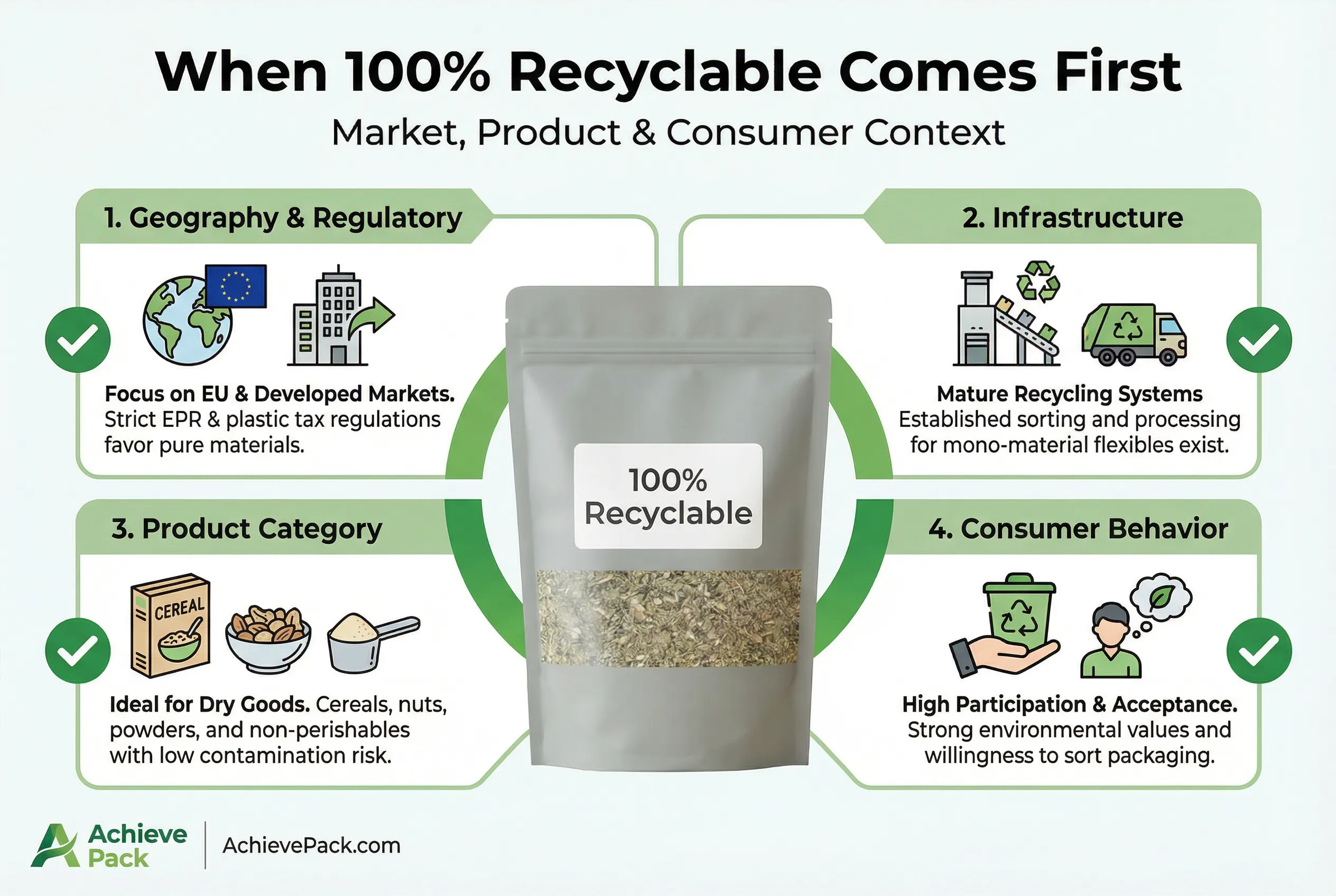
In many markets, especially those moving quickly on EPR and recyclability scorecards, recyclability is emerging as the foundational requirement.

100% recyclable design should come first when:

  • Your top markets have some level of collection and sorting for plastics, but industrial or home composting is limited
  • Retail and platform guidelines emphasise recyclability grades and penalise hard‑to‑recycle formats
  • Your current flexible packs rely heavily on multi‑material laminates that have little chance of being recycled

In these situations, transitioning to Eco Digital mono‑PE pouches resets your packaging onto a more future‑proof foundation.

When 100% Recyclable Design Should Be Your First Move
Recyclability emerging as the foundational requirement in most markets
Click to enlarge
Where PCR Comes In Once Recyclability Is in Place
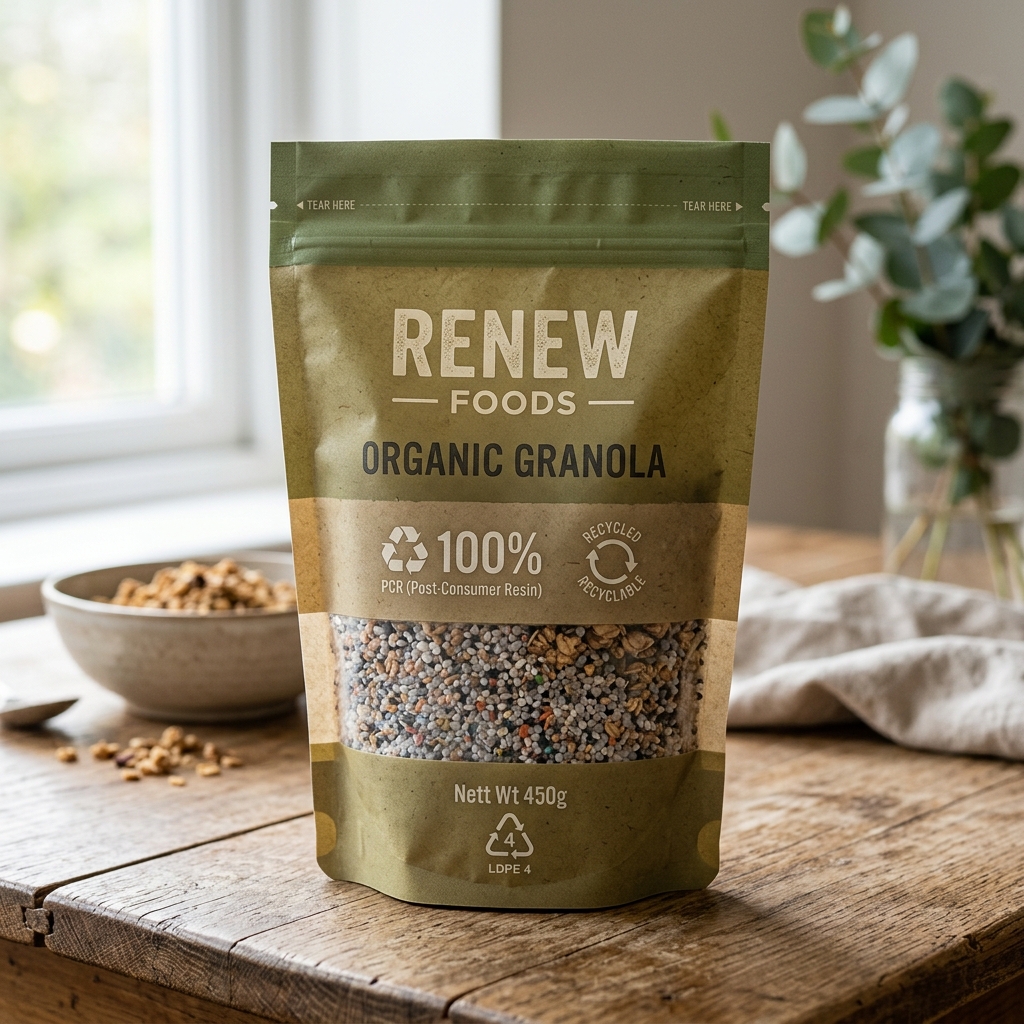
PCR becomes high-leverage once recyclability is in place
Click to enlarge

Where PCR Comes In Once Recyclability Is in Place

Once your packs are designed as 100% recyclable, PCR content becomes a high‑leverage next step.

Benefits of layering PCR onto recyclable designs:

  • Direct reduction in virgin plastic use, supporting resource and climate goals
  • Alignment with emerging regulations and voluntary commitments requiring minimum recycled content
  • Stronger sustainability messaging that combines "recyclable" with "contains X% post‑consumer recycled plastic"

Achieve Pack enables this through Eco Digital mono‑PE structures that can incorporate PCR PE while remaining in the PE recycling stream.

Where Bio‑Based Content (Bio‑PE) Fits in the Mix

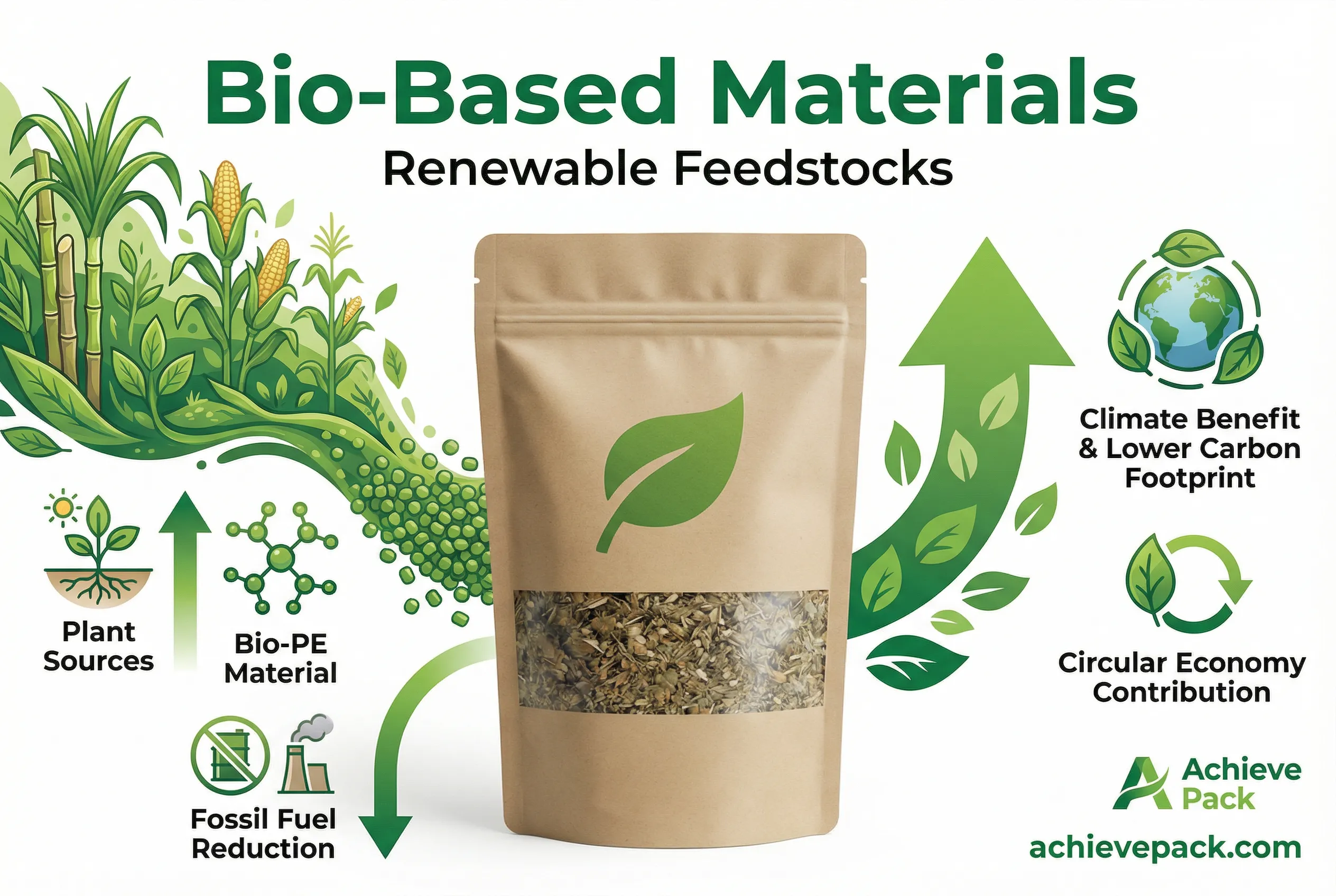
Bio‑based PE—produced from renewable feedstocks like sugarcane—adds a climate and resource dimension without changing how the pack is recycled.

Key points:

  • End‑of‑life compatibility maintained: bio‑PE is treated as PE in sorting and recycling
  • Lifecycle studies typically show lower cradle‑to‑gate greenhouse gas emissions due to plant‑based CO₂ uptake
  • Bio‑based content helps meet or exceed internal or external climate targets for packaging

In an Eco Digital mono‑PE context, brands can have 100% recyclable packs that are also partially or fully bio‑based.

Where Bio‑Based Content (Bio‑PE) Fits in the Mix
Bio-PE adds climate and resource benefits without changing recyclability
Click to enlarge
A Prioritisation Roadmap for SME Brands
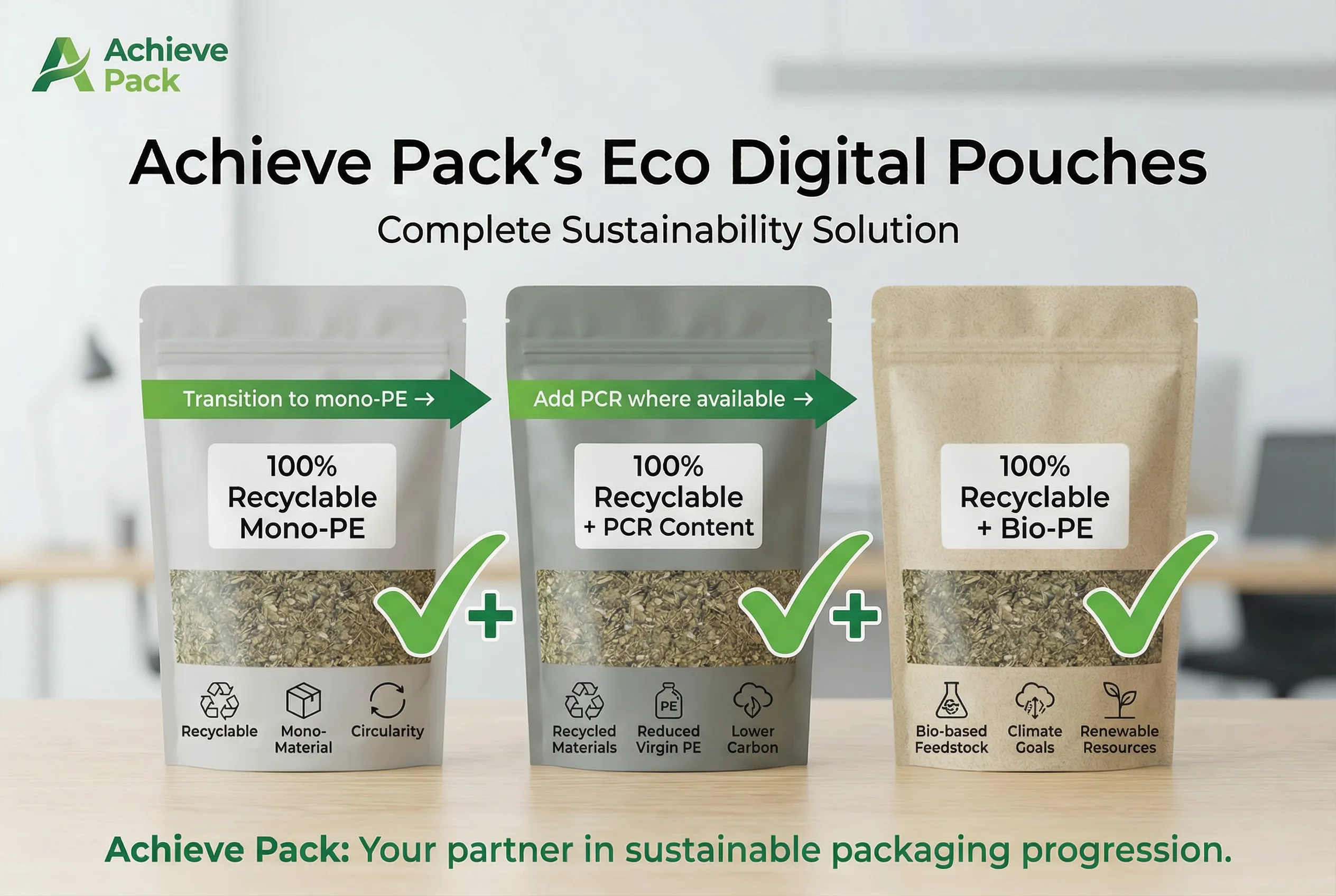
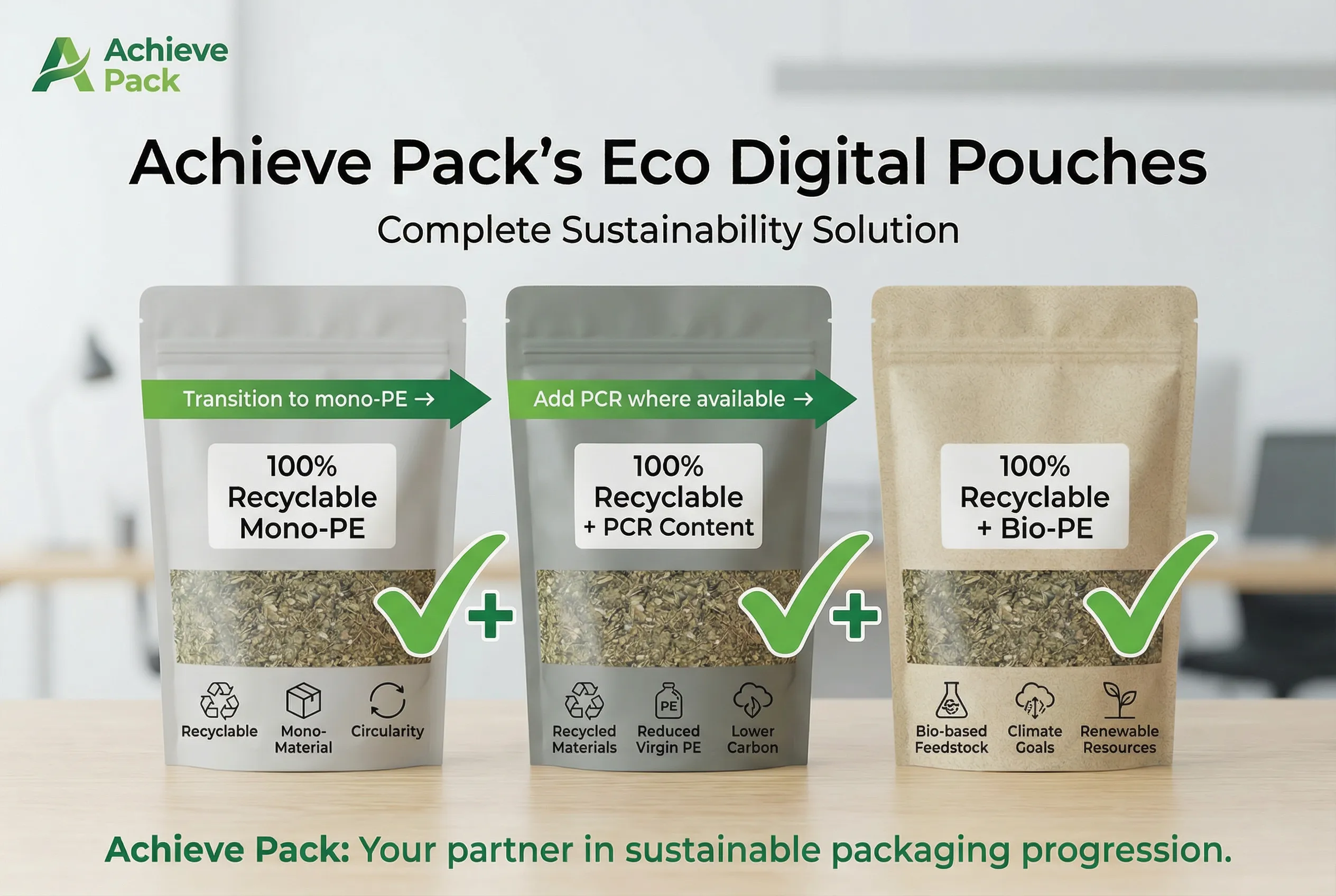
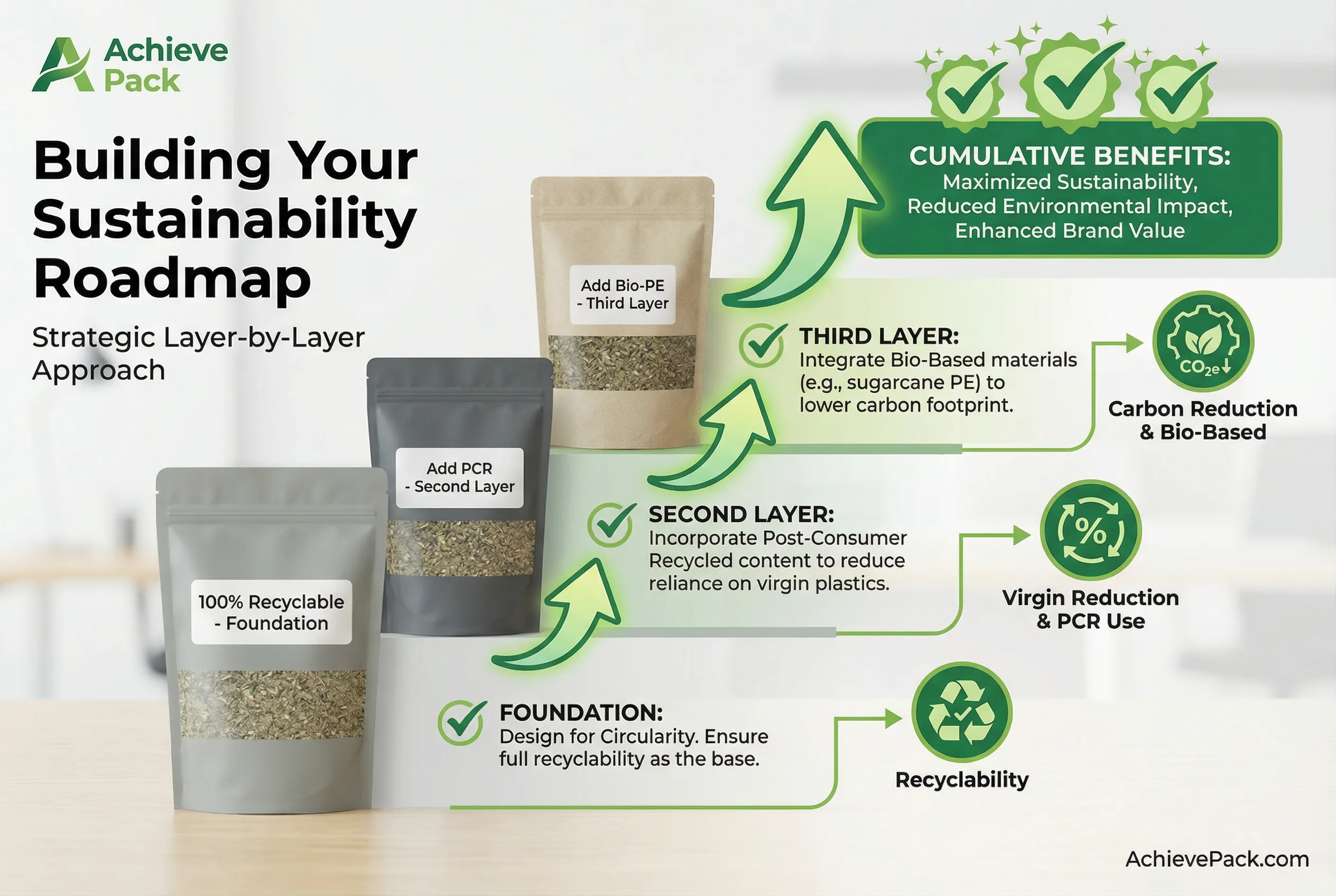
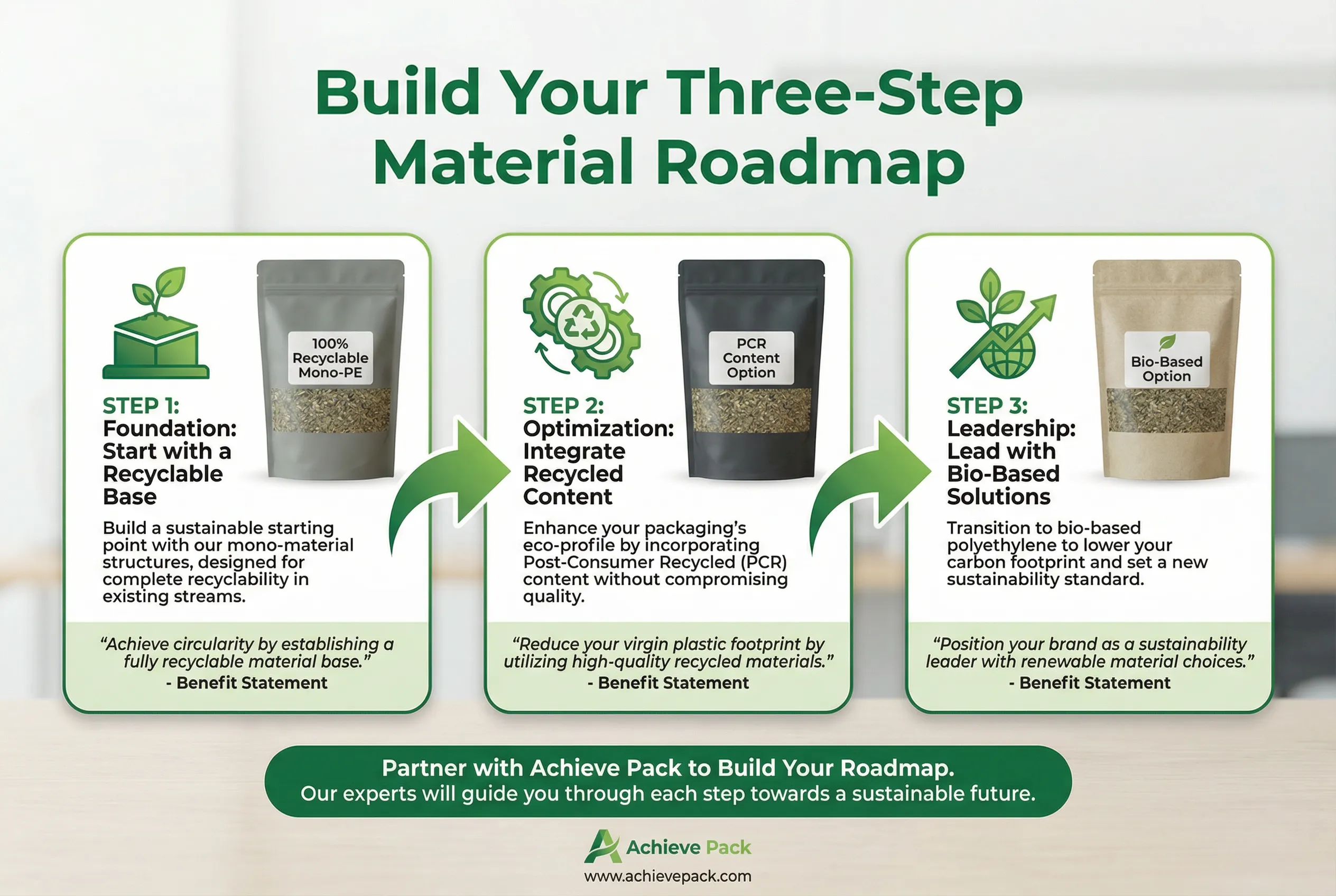
A pragmatic sequence: recyclability → PCR → bio-PE
Click to enlarge

A Prioritisation Roadmap for SME Brands

A pragmatic way to sequence these levers is:

Step 1 – Design for Recyclability

  • • Re‑specify key SKUs as mono‑material Eco Digital mono‑PE pouches
  • • Eliminate the most problematic multi‑material films first
  • • Focus on high‑volume or high‑visibility lines

Step 2 – Add PCR Content

  • • Introduce 20–30% PCR into selected mono‑PE structures
  • • Increase over time as supply and performance allow
  • • Use PCR first on SKUs where retailer or regulatory pressure is strongest

Step 3 – Introduce Bio‑PE

  • • Use bio‑PE in mono‑PE structures for premium or flagship lines
  • • Highlight "recyclable and bio‑based" in on‑pack communications
  • • Target SKUs where climate metrics and feedstock stories resonate

This staged approach allows your team to build capabilities and confidence one lever at a time, rather than managing all three simultaneously.

How Achieve Pack's Eco Digital Portfolio Fits This Prioritisation

Achieve Pack's Eco Digital flexible packaging system is designed to support this hierarchy:

  • Recyclable design: Eco Digital mono‑PE as the default path to 100% recyclable flexible packaging
  • PCR content: Integration of food‑grade PCR PE into mono‑PE structures without breaking recyclability
  • Bio‑PE: Use of bio‑based PE grades to lower fossil feedstock use while retaining PE end‑of‑life

Because the same Eco Digital platform supports all three levers, brands can gradually shift structures and messaging without fragmenting suppliers or technologies.

How Achieve Pack's Eco Digital Portfolio Fits This Prioritisation
One platform supports all three sustainability levers
Click to enlarge

Frequently Asked Questions

Should I prioritise recyclability or PCR content first?
For most markets, recyclability should come first. A 100% recyclable mono-material structure creates a foundation that can accept PCR later. Putting PCR into a non-recyclable laminate doesn't improve end-of-life outcomes—you're just adding recycled content to a pack that still won't be recycled.
Can I have recyclability, PCR and bio-based content all in one pack?
Yes. Eco Digital mono-PE structures can be 100% recyclable, contain PCR PE, and use bio-PE (sugarcane-based PE). All three levers are compatible in a PE recycling stream. Achieve Pack can help you layer these progressively.
What does bio-PE add if the pack is already recyclable with PCR?
Bio-PE addresses upstream carbon and feedstock: the resin comes from renewable sugarcane rather than fossil sources. Lifecycle studies typically show lower cradle-to-gate emissions. It's a climate lever that complements recyclability and recycled content.
How do I decide which SKUs to convert first?
Start with high-volume or high-visibility SKUs where sustainability messaging has the most impact. Focus on SKUs currently in hard-to-recycle multi-material laminates. These conversions give you the biggest sustainability uplift and strongest story to tell.
Will EPR regulations require recyclability or PCR first?
Most EPR schemes prioritise recyclability—packs that can't be recycled face higher fees or restrictions. PCR mandates are emerging but secondary to recyclability requirements. Getting your packs recyclable first positions you well for both types of regulation.
What's a realistic timeline to implement all three levers?
Many SME brands take 12-24 months to fully sequence recyclability, PCR and bio-PE across key SKUs. Year one focuses on recyclable design, year two adds PCR, and year three introduces bio-PE in targeted lines. Achieve Pack can help you build a phased roadmap.

Ready to Build Your Material Roadmap?

Most SME brands don't need more options—they need an order of operations. Starting with 100% recyclable design, then layering in PCR and bio‑based content, is a robust sequence for many markets.

If your team is deciding how to prioritise these levers, Achieve Pack can help you:

  • Map market infrastructure and regulatory expectations across your main geographies
  • Decide which SKUs should move first to Eco Digital mono‑PE, which need PCR, and where bio‑PE fits
  • Build a multi‑year material roadmap that keeps your packaging ahead of retailer and policy curves
Order Sample PackBrowse Store
Material roadmap for sustainable packaging
Click to enlarge
Still reading the footer? You must be serious.
$40+ sample kit — credited to your first order. Or book 15 minutes with a human.
Get the Sample KitBook a Call
WhatsApp (Real Person)LIVE
Book Meeting (Real Person)1:1
AI Packaging Assistant

We use cookies to improve your experience. View our Cookie Policy.