Barrier Properties
The Hard Data
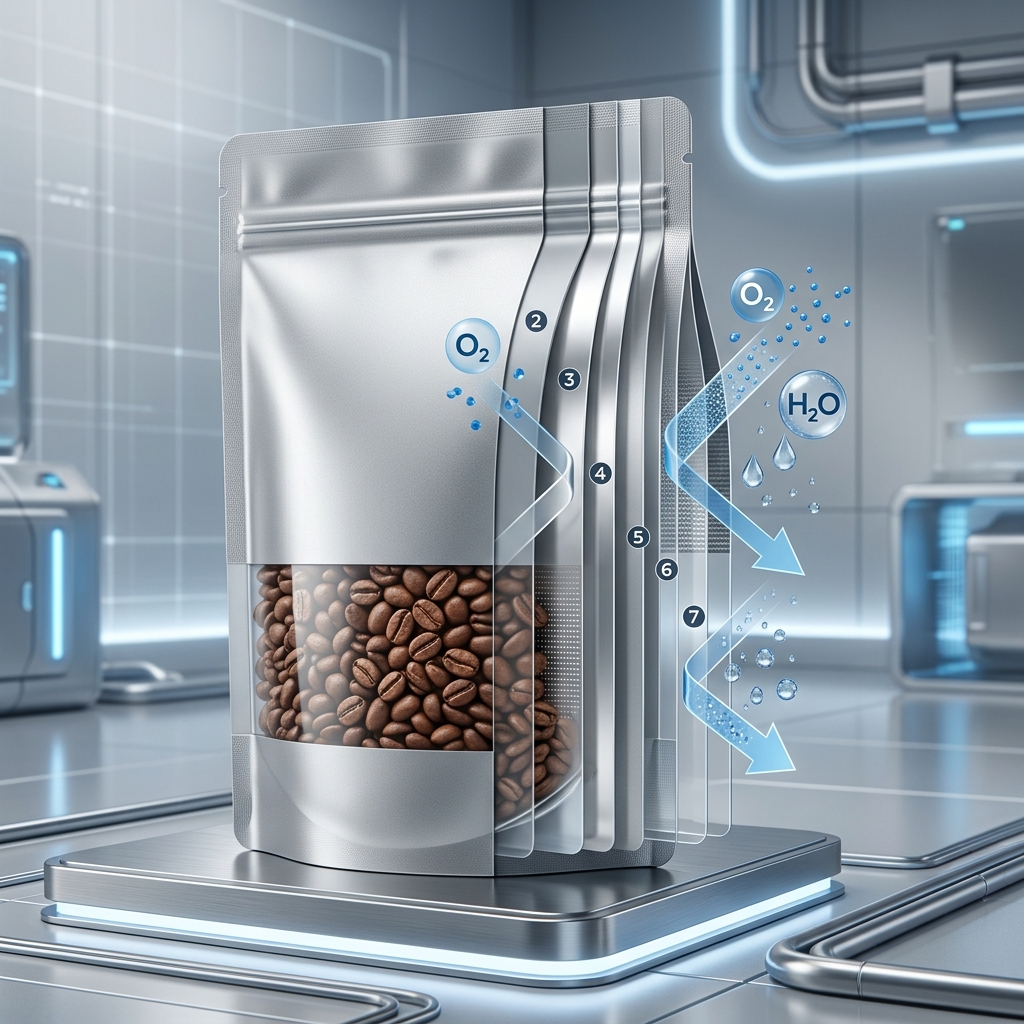
Oxygen Transmission Rate (O₂ TR) and Water Vapor Transmission Rate (WVTR) across standard flexible packaging layers.
Key Metrics
O₂ Transmission Rate
Oxygen barrier performance.
* Lower values = better barrier
Water Vapor Trans.
Moisture barrier performance.
* Lower values = better barrier
The Data
Values are typical industry averages and vary based on exact film manufacturer, thickness tolerances, and environmental conditions.
| Material | O₂ TR cc/m² 24hrs | WVTR g/m² 24hrs |
|---|---|---|
| OPP 20 | 1900 | 6 |
| OPP 30 | 1800 | 5.8 |
| OPP 40 | 1700 | 5.5 |
| PET 12 | 85 | 55 |
| NY 15 | 45 | 260 |
| CPP 20 | 2000 | 6 |
| CPP 30 | 1800 | 5.5 |
| CPP 40 | 1700 | 5 |
| VMCPP 25 | 25 | 1 |
| VMPET 12 | 2 | 2 |
| AL 7 | 1 | 1.4 |
| Material | O₂ TR cc/m² 24hrs | WVTR g/m² 24hrs |
|---|---|---|
| AL 9 | 1 | 1.1 |
| LLDPE 40 | 5000 | 18 |
| KOP 21 | 10 | 4 |
| KNY 17 | 8 | 12 |
| KPET 12 | 8 | 12 |
| PEARL 30 | 2200 | 9 |
| MAT OPP 20 | 1900 | 6 |
Translation for Humans
Transparent Films
PET / NY / OPP
PET and NY offer significantly better oxygen barriers out-of-the-box compared to standard OPP.
Metallized Magic
VMCPP / VMPET
Vacuum Metallizing vastly improves both moisture and oxygen barriers, upgrading clear films into high-barrier giants.
The Ultimate Shield
Aluminum Foil (AL)
The absolute highest barrier available. Knocks both transmission rates down to ~1. Cannot be seen through.
Clear But Mighty
PVDC Coated (KOP/KNY)
Applying a "K" (PVDC) coating dramatically boosts the barrier while keeping the film completely transparent.
5 Common Material Barrier Properties Problems (And Solutions)
11. Moisture Ingress & Clumping
Moisture penetrates the packaging, causing powders to clump or dry goods to become soggy.
Use high-barrier Aluminum (AL) or Metallized films (VMPET/VMCPP) with ultra-low Water Vapor Transmission Rate (WVTR).
22. Oxidation & Flavor Loss
Oxygen enters the package, degrading active ingredients, coffee, or oils, leading to staleness.
Incorporate EVOH, Aluminum foil, or specialized K-coated films (KPET/KNY) for extreme oxygen barrier.
33. UV Light Degradation
Ultraviolet rays penetrate transparent films, causing discoloration and breakdown of sensitive nutrients.
Add completely opaque layers like Aluminum foil or use specialized UV-blocking inks and coatings.
44. Flex-Cracking During Transport
The barrier layer breaks due to folding and vibration during shipping, compromising protection.
Use Biaxially Oriented Nylon (BOPA) or ALOX/SIOX coated PET for high flexural strength and resilience.
55. Chemical & Oil Attack
Aggressive contents like spices, essential oils, or chemicals dissolve or delaminate standard sealant layers.
Deploy specialized chemical-resistant sealant layers like HDPE, special CPP, or specialized tie-layers.
Still Not Sure?
These numbers can be dizzying! Book a FREE consultation to get a recommended barrier stack for your specific product!
Request Free Consultation