Plastic Free.
Compostable.
Demystified.
Your customers are reading the back of the pack now. Before you print "plastic-free," know exactly what's in your laminate — bioplastics, barrier coatings, adhesives, and the claim each one can actually support.
> Bioplastics vs. fossil polymers.
> Plant-based barrier mechanics.
> Curbside composting compliance.
> Verified BPI & TUV certifications.
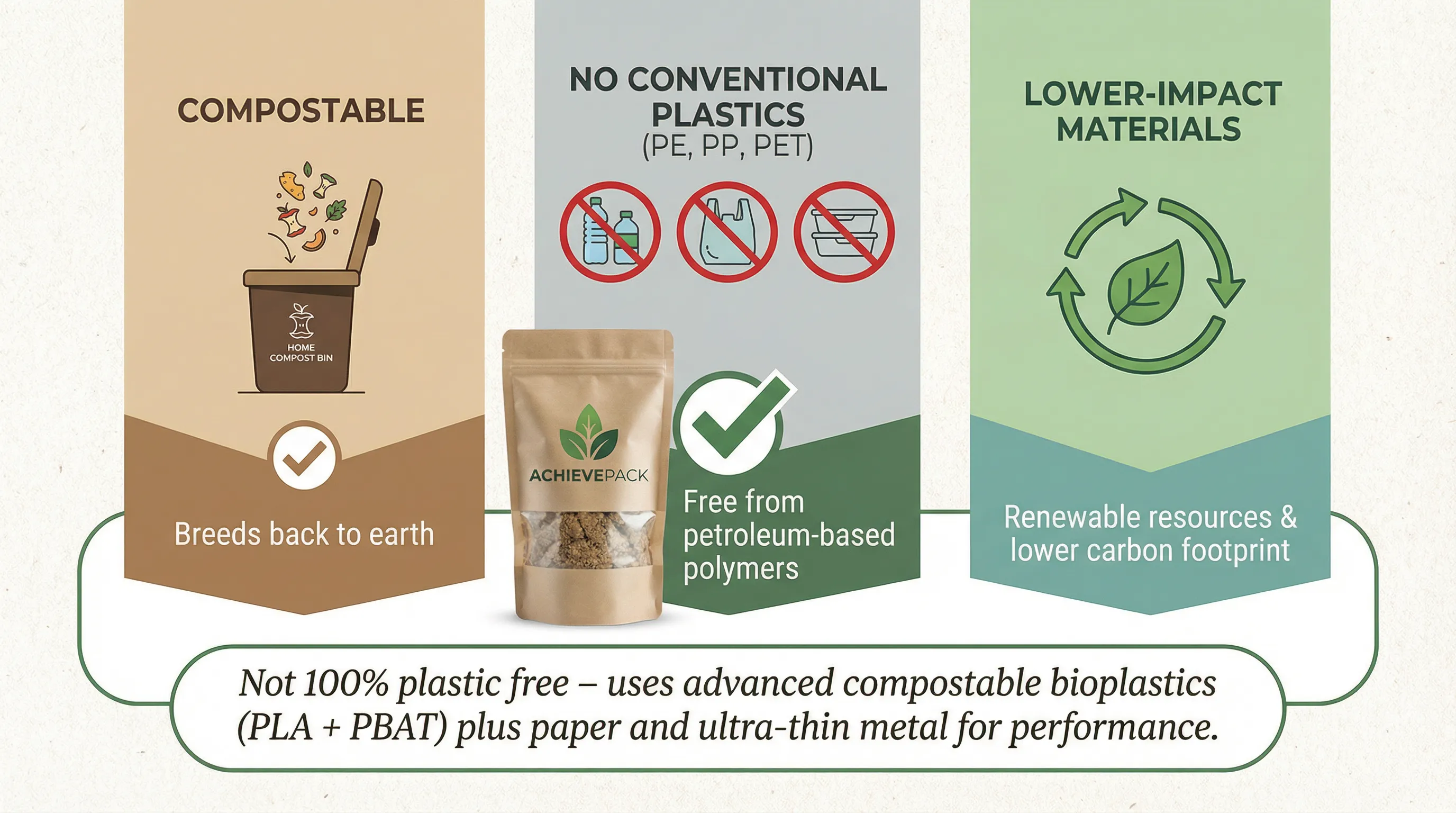
Understanding the Terms
What is Compostable?
A material is certified compostable if it breaks down entirely into water, CO2, and nutrient-rich biomass under specified composting conditions, leaving zero toxic chemical residues or microplastics behind.
What is Plastic-Free?
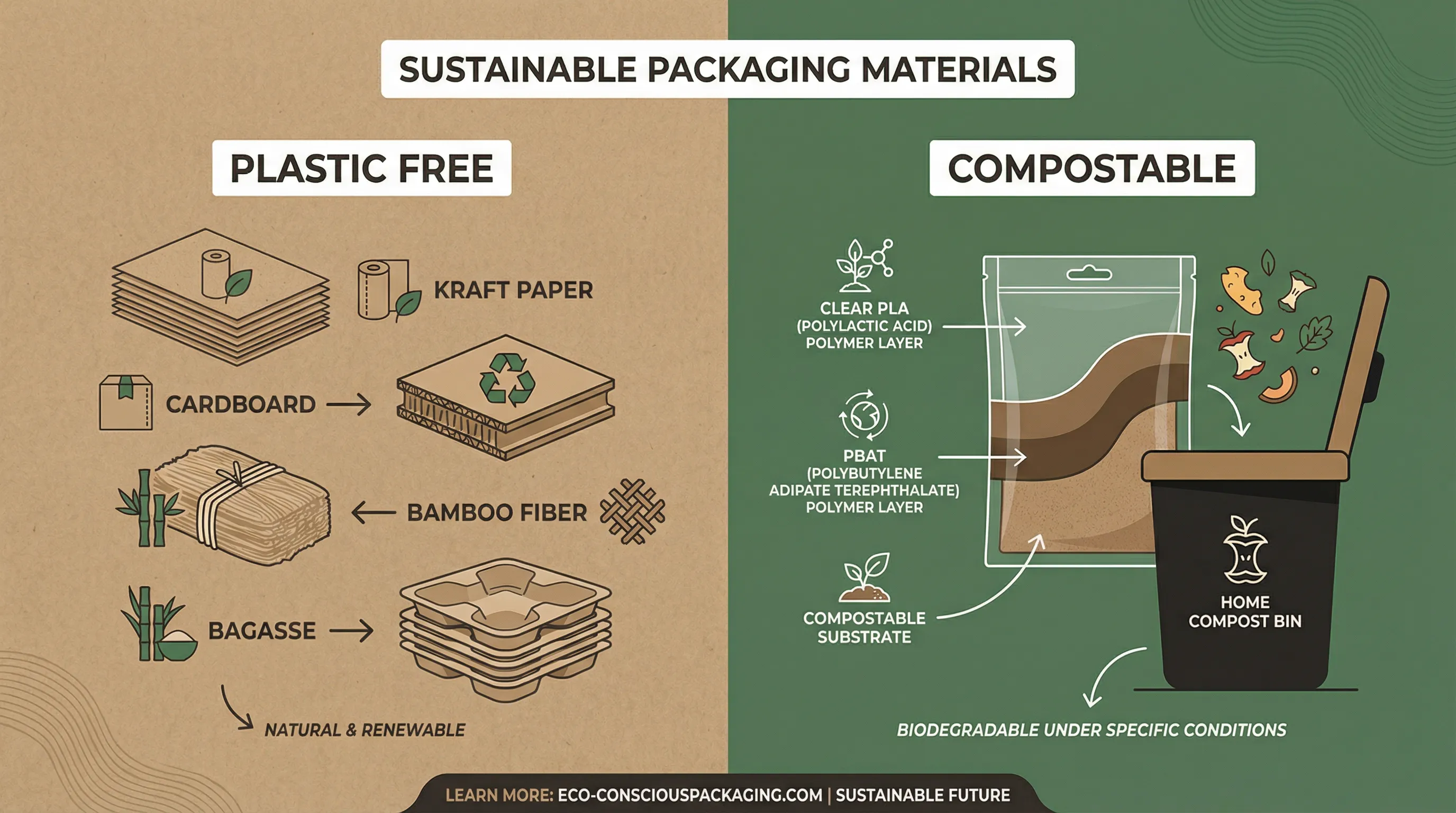
In the strictest legislative sense, "plastic-free" refers to materials containing absolutely zero synthetic or bio-derived polymers. This restricts choices strictly to raw papers, cardboards, and natural bamboo fibers.
What "Plastic-Free" Claims Can NOT Survive
- NOT a label you print before the spec is examined. Coatings, adhesives, and heat-seal layers all count. A kraft bag with a PE sealant layer is not plastic-free, whatever the front panel says.
- NOT the same as compostable. Plastic-free describes what's in the pack; compostable describes where it can end up. A pack can be one, both, or neither — your claim must match the certification you hold.
- NOT barrier-proof by default. Strictly polymer-free papers rarely block moisture and oxygen well enough for food shelf life. Most functional "plastic-free" pouches use biopolymer or mineral barrier layers — say so plainly.
- Want your laminate reviewed first? Send us your current spec and we'll tell you exactly which claim it supports. The $40+ sample kit is credited to your first order, or reach an engineer via /support/contact.
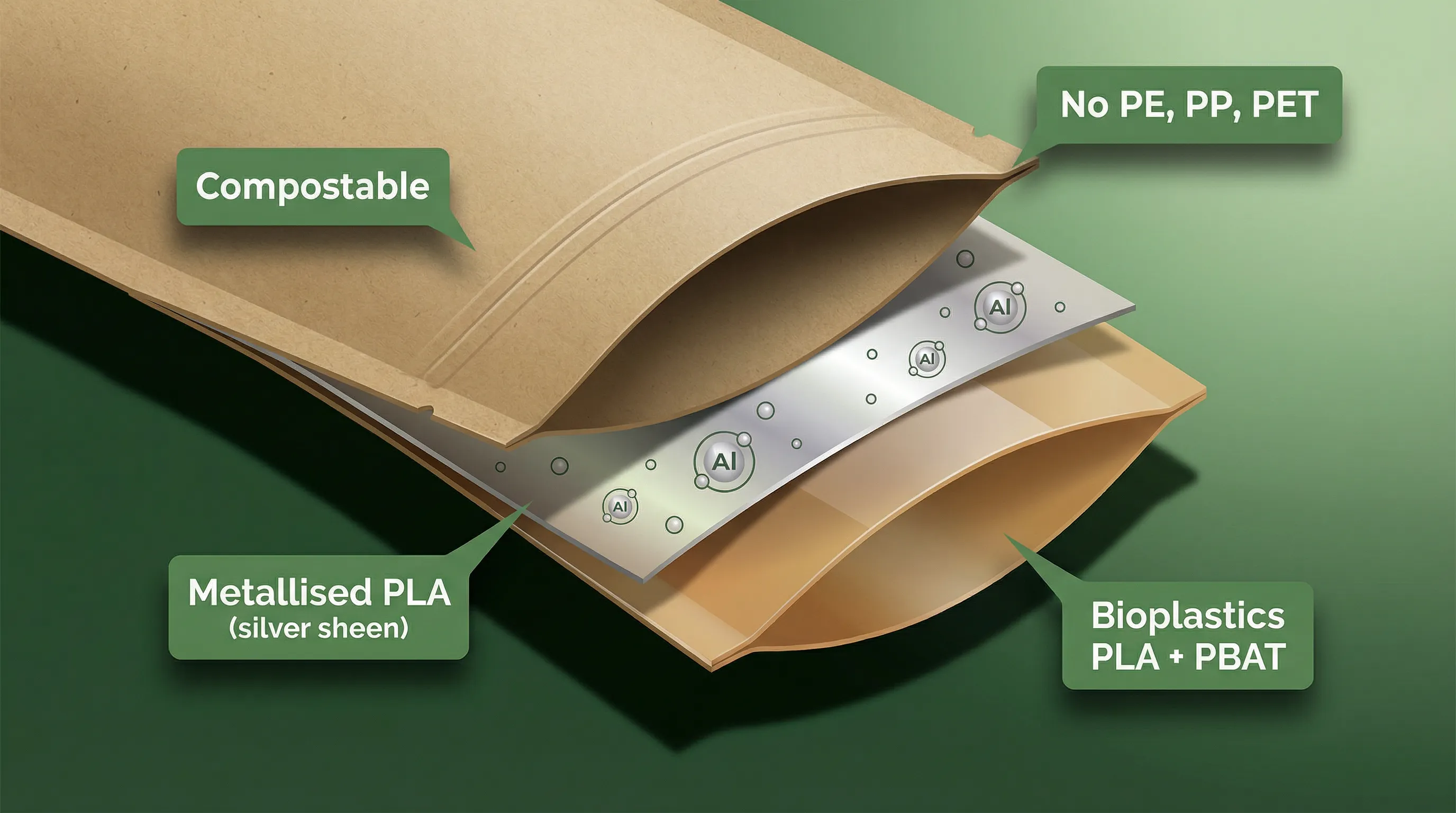
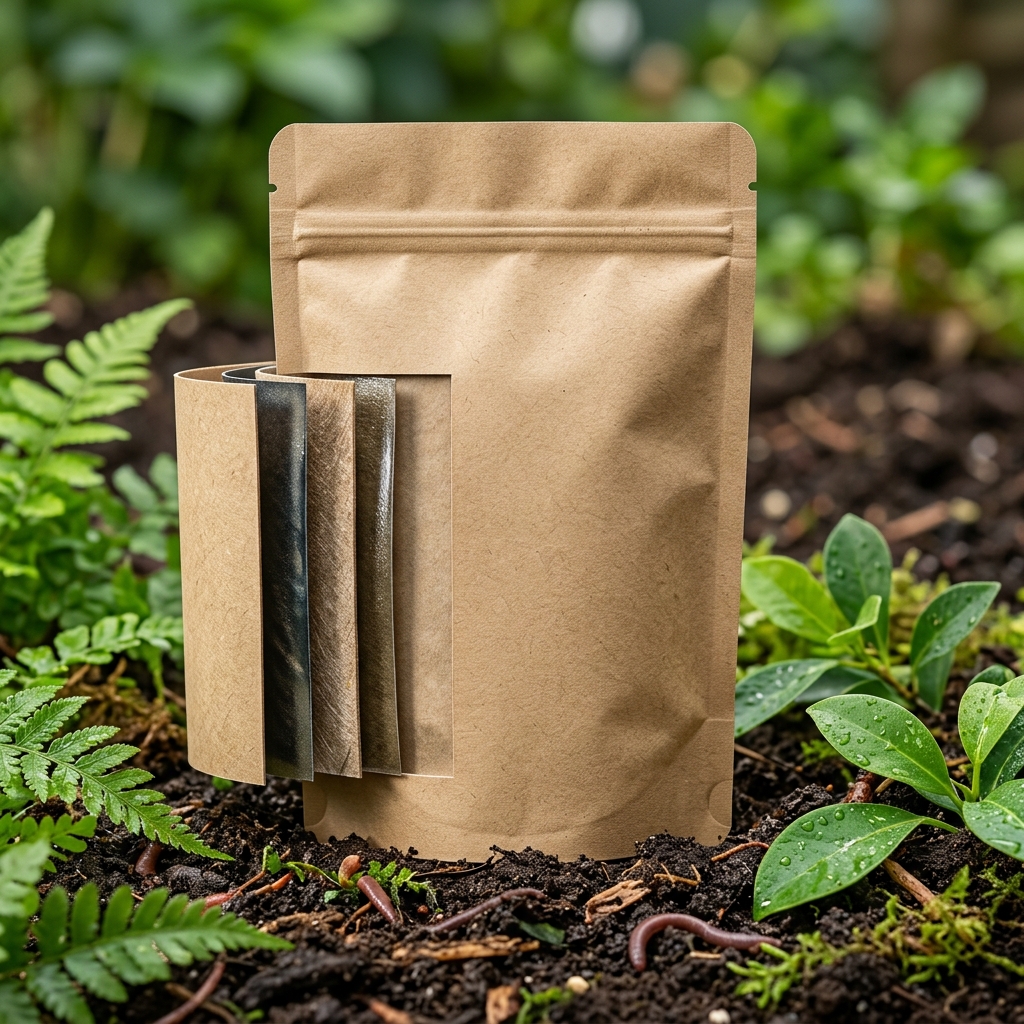
Our Certified Multi-Layer Structure
Rather than using deceptive greenwashing slogans, we lay out exactly what goes into our high-performance sustainable barriers:
01Outer Layer: FSC Certified Kraft Paper
Provides structural rigidity, a natural organic tactile aesthetic, and is 100% bio-based.
02Middle Layer: Metallized Cellulose (NKME)
An ultra-thin vapor-deposited mineral barrier layer that matches standard PET foil freshness (<1.0 cc/m²/24hr OTR/WVTR) without microplastics.
03Inner Layer: PLA + PBAT Sealant
Corn-starch derived polylactic acid (PLA) blended with biodegradable adipic acid polyester (PBAT) for flexible heat-sealing.
5 Common Plastic-Free Packaging Problems (And Engineering Solutions)
1. Poor Barrier Properties
Problem: Natural materials let moisture and oxygen in, spoiling food fast. Solution: High-barrier metallized cellulose layer ensures shelf life matches traditional plastics.
2. Weak Structural Integrity
Problem: Eco-pouches tear easily or puncture. Solution: 3-layer laminated construction with FSC Kraft and PLA provides industrial-grade burst strength.
3. Heat Seal Failure
Problem: Leaks at the seals because bioplastics don't melt uniformly. Solution: Advanced starch-based heat seal resins that activate cleanly at low temperatures.
4. Misleading 'Greenwashing'
Problem: Many 'plastic-free' bags still leave microplastics. Solution: Fully verified materials ensuring zero toxicity and 100% compostability.
5. Poor Print Quality
Problem: Kraft paper absorbs ink poorly, looking cheap. Solution: Water-based digital printing on specially treated eco-films for vibrant, premium branding.
Value Specs Matrix
Metallized Cellulose (NKME)
An ultra-thin vacuum-deposited aluminum layer — nanometres thick, a trace amount rather than an aluminum foil layer — that preserves freshness (<1.5 cc/m²/24hr OTR) without leaving microplastics or toxic residues in municipal compost.
Kraft Paper + NKME + PLA/PBAT
A fully certified three-layer plant-based structure designed to biodegrade entirely in 90-180 days in an industrial composting facility.
Starch-Based Heat Seal Resin
Low-temperature activation layer ensures airtight food-grade hermetic seals on standard automatic packaging lines, preventing air leaks.
Water-Based Eco Inks
Premium high-resolution printing using non-toxic water-based inks that disintegrate safely without chemical contamination of finished organic compost.
How Brands Navigate the Eco-Packaging Spectrum
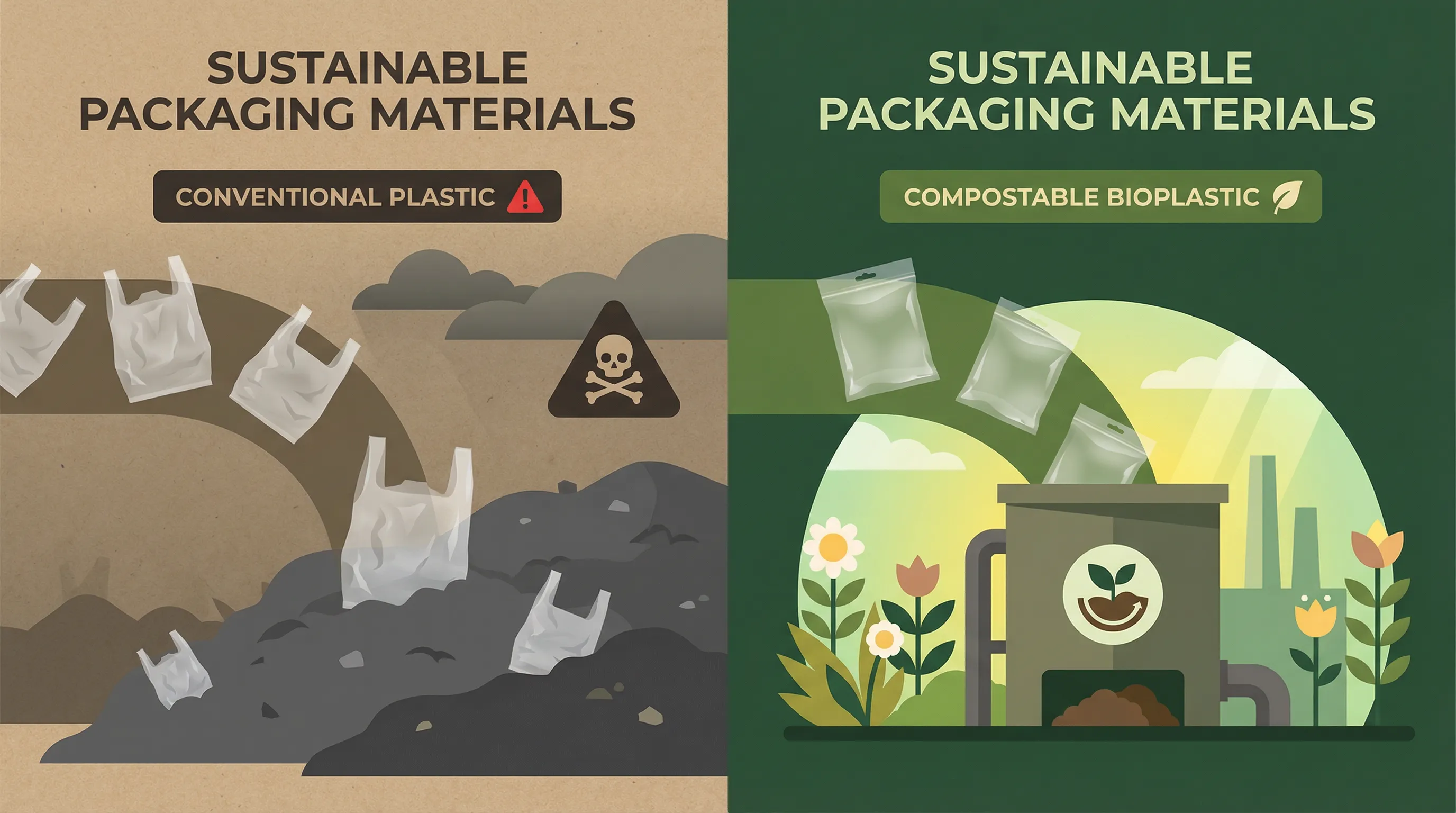
Many retail food and consumer brands face regulatory pressure and customer demand to reduce single-use plastic waste. However, standard raw papers lack the barrier properties needed to block oxygen, light, and humidity. Without high barriers, product shelf life collapses, leading to spoilages and packaging rupture.
To solve this, advanced bio-polymer stacks have emerged. These structures (such as PLA and PBAT) behave like standard plastic films during production and sealing, but disintegrate entirely into organic biomass inside industrial composting environments.
Drafting Compliance Claims
We highly recommend brands maintain complete honesty in their marketing to build long-term trust. Rather than using sweeping "100% plastic-free" labels that can get flagged by advertising standard authorities due to the starch-polymer layers, we suggest using transparent phrasing such as:
This builds absolute credibility with conscious consumers and aligns directly with regulatory guidance.
Procurement & Compliance FAQ
Clear answers to your technical compliance and ordering questions.
Begin Your Custom Run
High-performance certified compostable packaging starting at 500 units.
For high-volume retail supply runs (10,000+ units), custom rotogravure cylinder contracts, or enterprise pricing structures, please visit our enterprise portal: achievepack.com/composting/plastic-free →